
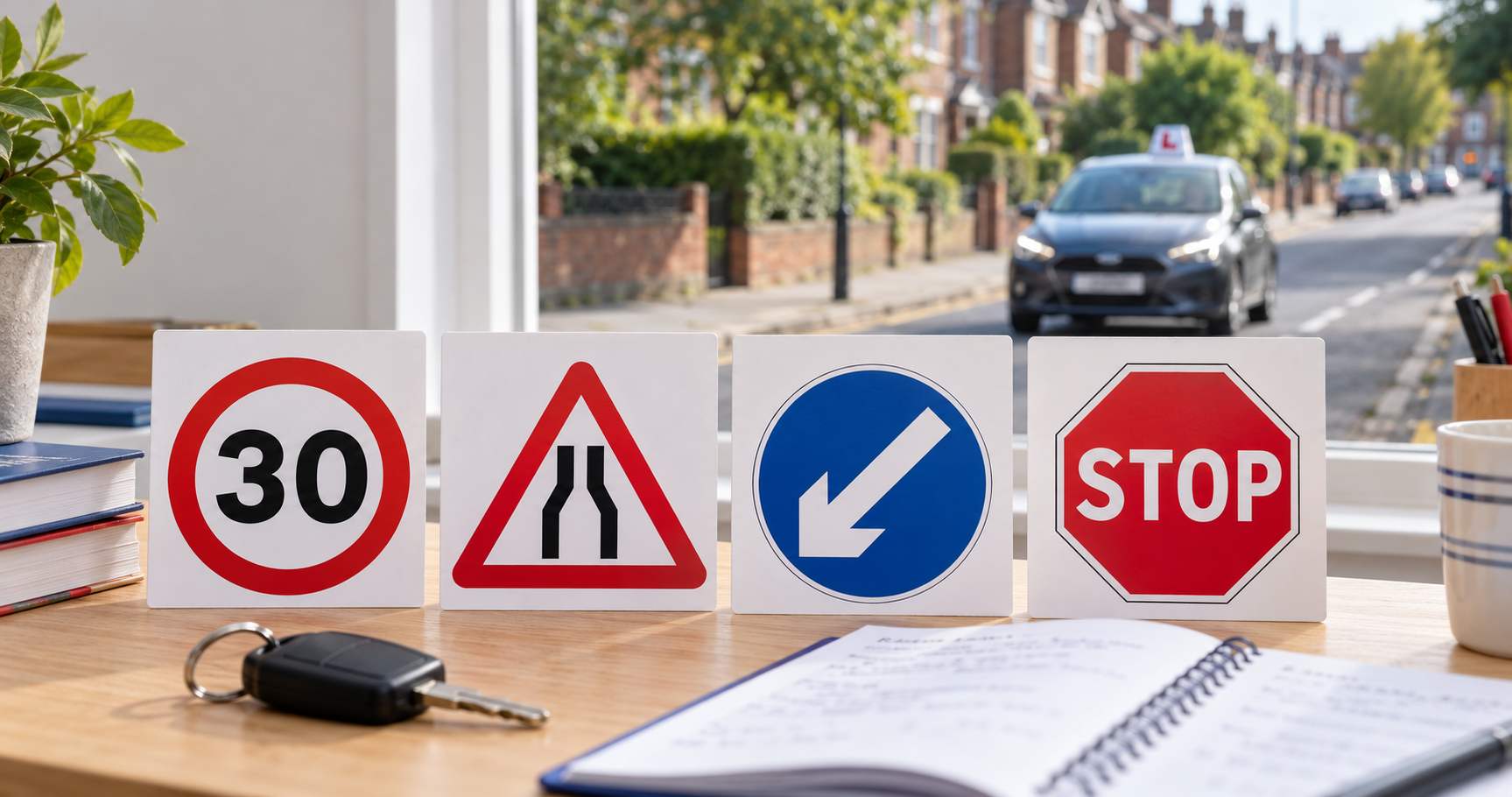
I can build confidence by learning how signs communicate, one clear clue at a time. In the UK, road signs help me make safer choices while learning to drive, whether I am in a car or preparing for test day.
Recognising a sign is only the start. I also need to notice its message in time to respond calmly, rather than act at the last moment. A supplementary plate is a small panel beneath a sign that adds detail or qualifies the sign’s message.
Knowing what to look for can make each drive feel more manageable. I will move from sign patterns to using them on real roads, with practical steps I can build on over time.
How do UK road sign shapes and colours work?
As I approach an unfamiliar sign, its shape and colour give me an initial clue about its message. First, I can sort many traffic signs by their broad visual group.
Shape and colour suggest a sign’s function, but they do not tell the whole story. These useful patterns can help me read UK road signs and meanings more quickly.
Shape and colour offer a quick clue, not a complete answer. I still need to read the whole sign.
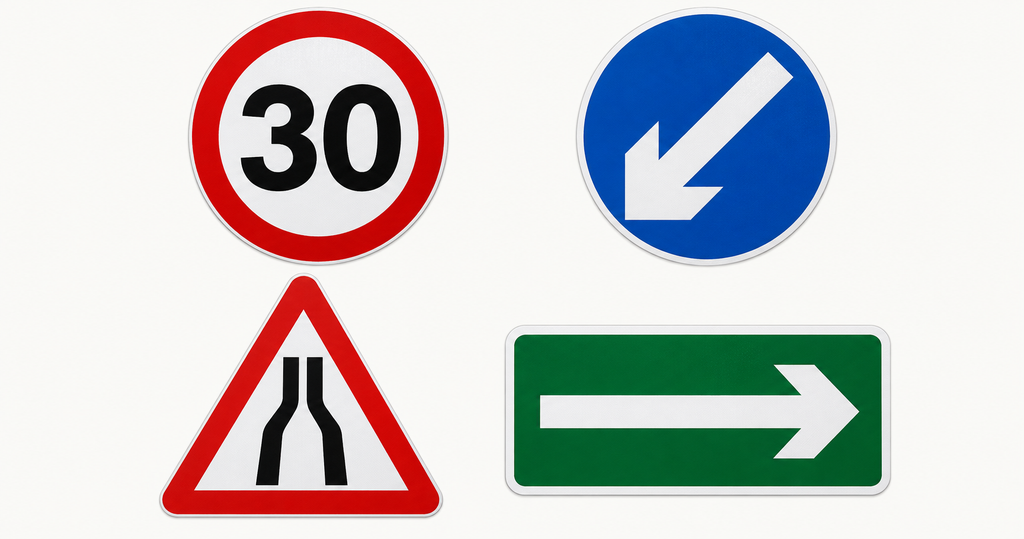
| Visual group | Usual shape or colour | Broad message | Examples |
|---|---|---|---|
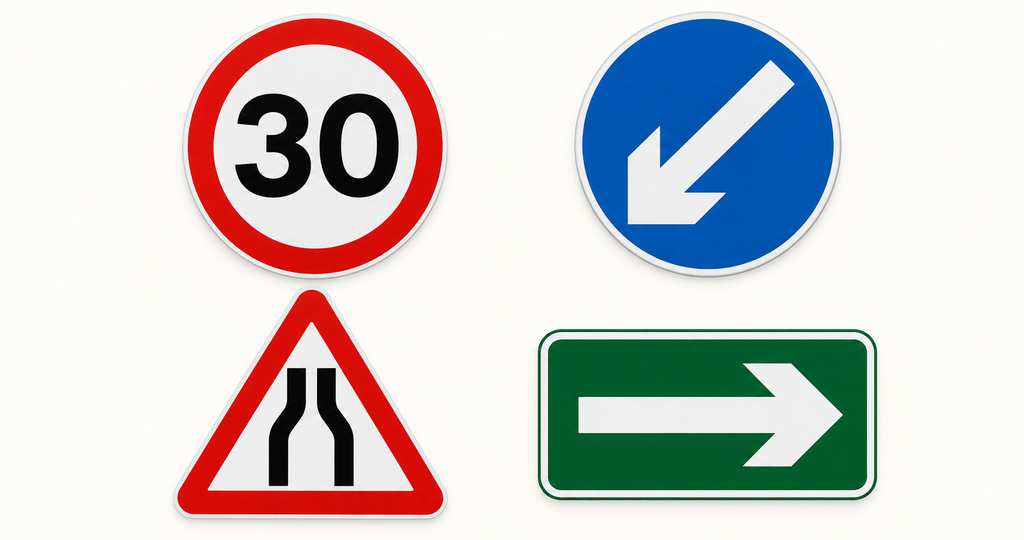
| Red circles | Red circle | Order or restriction | Maximum speed |
| Blue circles | Blue circle | Positive instruction | Keep left |
| Triangles | Triangle | Warning ahead | Road narrows |
| Rectangles | Rectangle | Information or direction | Route destination |
These groups are patterns, not a full catalogue of every sign. A supplementary plate beneath a sign can qualify its message, so I should check that panel too.
The Highway Code does not draw every sign to the same scale. Older sign designs may still appear on roads, so a familiar message can have a slightly different look.
In Wales, I may see signs in both English and Welsh, including place names. The wording can differ while the sign still gives a clear direction.
Shape and colour are a useful start when reading road signs in the UK. Next, I need to identify orders and restrictions that call for a specific response.
Driving Test Signs: Which orders and restrictions should I recognise?
I should read an order sign as a rule to obey, then identify exactly what it requires. Read the full message before choosing what to do.
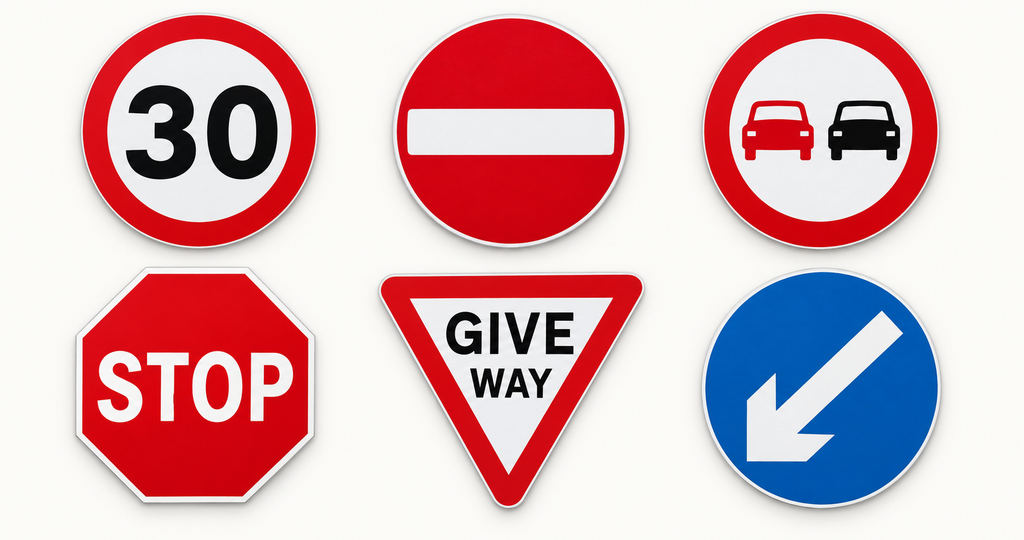
Red-circle signs mostly prohibit an action, while STOP and give way are separate instructions. Some restrictions depend on a vehicle’s type, size or weight.
Prohibitions and vehicle restrictions
Examples include maximum speed, no entry, no overtaking, no U-turn and no left or right turn. Signs can also prohibit cycling, or restrict vehicles by type.
Other signs set limits for vehicle height, width or weight. A tall vehicle, for example, must not pass a height restriction if it exceeds the displayed limit.
Stopping, waiting and parking can also be restricted. A supplementary plate may show times when the rule applies, or state that a permit is needed.
I should treat those details as part of the message, not as extra decoration. A sign that looks familiar may set a different rule at certain times.
Priority, turning and mandatory instructions
STOP and give way have distinct meanings, so I need to learn each instruction on its own. At a STOP sign, I must stop; a give-way sign tells me to give priority to other traffic.
Blue-circle signs generally tell me to take a positive action. They include ahead only, keep left and minimum speed instructions.
They can also mark cycle-only routes, bus and cycle routes, or routes for buses and cycles. These examples are not a complete list, so I should read the symbol and any wording carefully.
Once I know whether a sign prohibits or directs me, I can act with more confidence. Warning signs take a different role: they alert me to a hazard ahead.
Which warning signs help me spot hazards ahead?
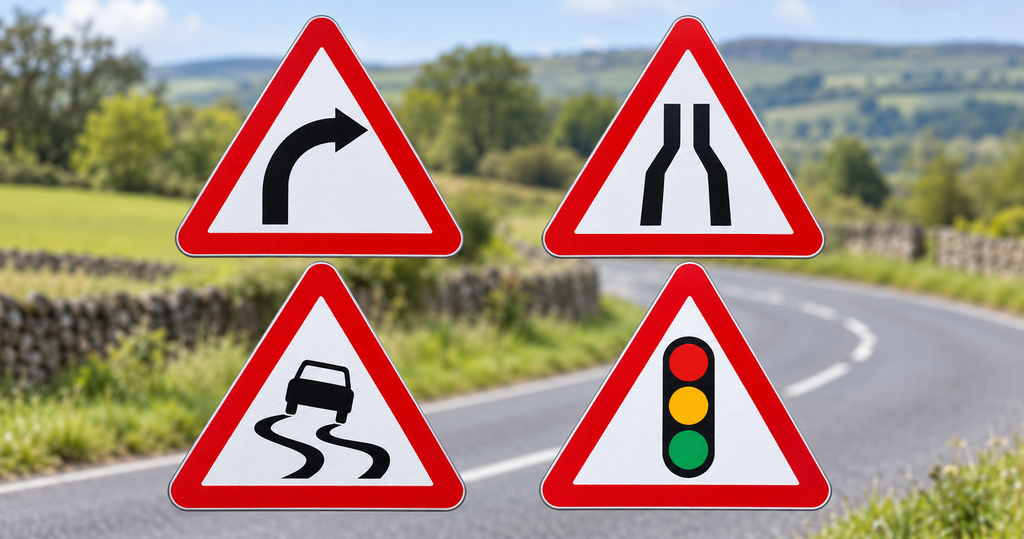
A warning sign gives me time to assess a bend, slippery stretch or other possible hazard before I reach it. Early notice can help me respond smoothly.
A warning identifies a risk to assess, not an order to make a sudden manoeuvre. I should look ahead and adjust only when the road conditions call for it.
Here are five groups of warning signs and the thought each one should prompt:
- Road layout: bends, roundabouts, road narrowing or junctions on bends.
- Surface or gradient: slippery roads, steep hills, soft verges or ice.
- Crossings and people: traffic signals, level crossings, pedestrians or cyclists.
- Animals: signs warning of animals that may be on or near the road.
- Clearance or other hazards: low headroom, side winds or falling rocks.
Each sign alerts me to something that may lie ahead. I can check the road around me, leave room to respond and avoid making an abrupt move just because I saw a triangle.
Revision pages sometimes use the label “100 road signs and their meanings”. That wording can describe a broad set of examples, but it does not mean an official fixed set contains exactly 100 signs.
A “10 safety signs” list is also a selected revision set, not a separate fixed category established here. The examples are chosen for learning; they do not create an official classification.
The useful habit is to connect the warning with the risk it names, then judge what the road requires. Next, I can apply that measured approach to speed and temporary restrictions.
How do speed signs and temporary restrictions affect my drive?
A 20 mph zone has signs marking both its entry and its end. Those signs show when the zone begins and when its limit no longer applies.
I should follow the speed instruction shown for the road and its displayed conditions. A maximum speed sets an upper limit; a minimum-speed sign sets a lower one.
A maximum speed sign tells me not to drive faster than the displayed limit. It does not mean that speed is right for every moment, since traffic and road conditions still matter.
A minimum-speed sign has a different purpose. It sets a minimum, and a separate sign can mark the end of that minimum-speed requirement.
Signs may also show where the national speed limit applies. I should use the signs on the road to understand what applies, rather than assume a value from a different setting.
Roadworks can change the usual pattern. Signs may give a mandatory speed limit ahead, then mark the end of roadworks and the end of temporary restrictions, including temporary speed limits.
That start-and-end information matters. If I see a roadworks limit, I should not assume it continues forever, or that it ends before a sign says so.
The sign and its displayed conditions guide me through the change. Once I have read the rule on the road, route signs help me choose a lane and destination.
How do direction signs guide me through lanes and routes?
On a motorway approach, a downward arrow can show the lane I need before the junction. Early reading gives me time to plan rather than move at the last moment.
Motorway signs use blue backgrounds, while signs for a primary route use green backgrounds. The background and route number help me identify where a route leads.
A route designated as a primary route is a primary route. Direction signs also show local destinations and routes that do not have primary status.
Reading motorway and all-purpose route signs
| Route setting | Sign background or border | What the route clue means | Lane or destination detail |
|---|---|---|---|
| Motorway | Blue background | Blue route number points towards a motorway | Downward arrow means get in lane |
| Primary route | Green background | Green route number points towards a primary route | Destination shown on the route sign |
| Non-primary or local route | Black border | Local or non-primary direction | White panel can show a local route |
Motorway signs may use an inclined arrow for a destination reached by leaving at the next junction. I should read that arrow with the destination, not mistake it for a lane arrow.
Following arrows, panels and cycle routes
A blue panel can show that a motorway starts at the junction ahead. A white panel points to a local or non-primary route, while a brown panel shows tourist attractions.
Downward-pointing arrows mean I should get into the lane they mark. Reading them early can help me follow the route without a sudden lane change.
Some signs guide pedestrians and cyclists rather than motor vehicles. These can include recommended cycle routes, so I should check who the sign is for before following it.
Some signs in Wales are bilingual, including route information. Once I have chosen a route, I can look for signs about access, parking and lane use.
Which information signs affect parking, access and lane use?
On a street, a parking sign or lane panel can decide whether my planned move is allowed. Checking the whole sign helps me avoid following a route that does not suit my vehicle.
Information signs can change where I may go, stop or use a lane. Some identify facilities; others show access rules or the start and end of a controlled area.
Controlled parking zone signs mark where a zone starts and where it ends. I should look for those entry and exit signs, as well as the local parking details.
Other signs identify parking places, including spaces for solo motorcycles. A sign can also mark a congestion-charging zone, which affects whether I can continue as planned.
Motorway signs show the start and end of a motorway, and point to motorway service areas. Hospital and tourist information points can help me find a facility or destination.
A no-through road sign tells me vehicles cannot pass through to another road. This can save me from entering a street that does not lead where I expect.
Lane signs may identify high-occupancy vehicle (HOV) lanes, camera-enforced areas or a bus lane ahead. An HOV lane is for vehicles meeting the occupancy rules shown by its signs.
A with-flow bus lane may also be open to pedal cycles and taxis. I should read the named users, since a bus lane is not always for buses alone.
Some signs show priority between traffic on the main carriageway and traffic joining it. I can use that information to prepare at junctions and crossings, where signs also show layouts and priority.
How should I read signs at junctions and crossings?
At a signed junction, a preview of the layout helps me prepare before reaching the line. Knowing what lies ahead gives me time to check where I must stop or give way.
A sign can show both the junction shape and where a STOP or give-way line lies. A broader line marks the route with priority through the junction.
Reading junction layouts and priority
| Sign or layout clue | What it indicates | Priority or stopping information | Practical reading point |
|---|---|---|---|
| STOP-line distance | Distance to a STOP line | Stop at the line | Prepare to stop before reaching it |
| Give-way-line distance | Distance to a give-way line | Give way at the line | Look for the marked line ahead |
| Broader route line | Priority-through route | Broader line shows the priority route | Check the side road and traffic |
| T-junction layout | A road meets another road | Layout alone does not set priority | Read the signs and road markings |
Other signs can show crossroads, staggered junctions or junctions on bends. A clear preview helps me see which road meets mine and where traffic may approach.
Recognising pedestrian, rail and tram crossings
Crossing warnings cover different road users and settings. A pedestrian crossing sign alerts me to people crossing; I should watch the road and be ready to respond safely.
A level crossing warning marks a railway crossing. The crossing may have a barrier or may be without one, so I should follow its signs and signals.
Tram crossing warnings identify places where trams cross or share the route. I need to notice the crossing point and allow for the tram’s path.
Junction and crossing signs help me locate lines and people before I reach them. I can build that knowledge through structured practice and careful answer review.
How can I practise road-sign questions before test day?
Reviewing a wrong answer shows me what to revise, instead of letting the same gap remain. That small step can make practice more useful.
Know Your Traffic Signs, 2023 edition, is a 172-page PDF for England, Scotland and Wales. It accompanies the Highway Code and explains common signs.
It covers more than the signs commonly shown in the Highway Code. Its topics include warning, regulatory and speed-limit signs, low bridges, level crossings and road markings.
Use official learning material selectively
The same guidance covers motorway signs, direction signs, traffic signals, parking controls and roadworks. I can use its contents to find the areas that need more work.
It is a useful reference when I search for “all road signs for the theory test”. I can also look for a “UK road signs quiz with answers” or “road and traffic signs theory test questions”.
A short quiz can test a small sample, rather than every sign I may need to know. A high score on one set does not prove that I have mastered the subject.
Turn quiz mistakes into revision
I can keep the process simple and repeat it when an answer still feels uncertain:
- Answer a short quiz without rushing.
- Review each wrong or uncertain answer.
- Group errors by subject, such as crossings or road markings.
- Retest the weak areas after revision.
For each mistake, I can note what the question showed and why my answer did not fit. That gives me a clearer task than repeating the whole quiz without checking.
If a question includes a plate or a road setting, I should review that detail too. It may explain why a familiar sign has a different meaning in that case.
Once I know which subjects still trip me up, I can focus my next practice session. I can carry the same revision habit into live driving by reading the road in time to act calmly.
How can I use road signs confidently on a real route?
A beginner may recognise a sign but notice it too late to plan smoothly. Looking well ahead gives me more time to understand what it means for my route.
I can use a steady scan to spot signs early and plan a calm response. I should follow my instructor’s guidance and focus on safe observation, not a promised test result.
Recognising a sign is useful only if I notice it in time. I should read the whole message and plan calmly.
Scan, interpret and plan ahead
This four-part checklist can help me build a repeatable habit on familiar or unfamiliar roads:
- Scan beyond the car ahead to spot signs early.
- Identify the sign and any supplementary plate.
- Work out what the message means for my route.
- Plan a calm response while leaving time to act.
Looking beyond the vehicle in front can reveal a sign before it is hidden by traffic. I can then think about what it means without taking my eyes off the road for too long.
Avoid common sign-reading mistakes
A common mistake is recognising a sign’s colour but missing a time plate or vehicle restriction. That extra detail can change when a rule applies, or which vehicles it affects.
I should avoid guessing from a quick glance. If I am unsure, I can keep observing, follow my instructor’s advice and ask about the sign after the drive.
Confidence comes from repeated practice, not from trying to react to every sign at once. I can take one weak sign category into my next lesson or revision session.
You May Also Read: Sedecordle
Conclusion
Calm, early recognition is more useful than trying to memorise every sign in one sitting. I can read the whole message, including any supplementary plate, and use mistakes in practice to choose what needs more revision.
Before my next lesson, I can pick one unfamiliar sign category and review it. Small steps make the road easier to read, so I can take that next step with confidence.
FAQ
What do different types of road signs mean in the UK?
UK road signs warn about risks, set rules or give information and directions. Shape and colour offer common visual clues, such as triangles for warnings and circles for many orders. These patterns help me start reading, but they are not a complete classification. I should check the symbol, wording and any supplementary plate to understand the full message.
Is the theory test changing in 2026?
The facts here do not establish a change to the theory test in 2026. Test arrangements can be updated, so I should check the current official theory-test information for the latest details. I should avoid relying on an old quiz or an unconfirmed claim when planning revision. The Highway Code and current official learning material remain useful places to study road signs.
What are the three types of signs when driving?
A useful functional grouping has three types: warning, regulatory, and information or direction signs. Warning signs point out risks; regulatory signs set rules; information and direction signs help me find routes, places and facilities. People may count signs differently when they group them by appearance instead. The key is to read the sign itself and understand what it asks or tells me.
What are 10 common road signs?
Ten recognisable examples are no entry, maximum speed, give way, STOP, no overtaking, road narrows, roundabout, slippery road, pedestrian crossing and traffic signals. This is a selected revision set, not a complete official list. I can practise spotting what each sign means, then check any time, vehicle or route details that alter its message.
What are the four types of signs?
Four common visual groups are red circles, blue circles, triangular warnings and rectangular information or direction signs. Red circles often show prohibitions, while blue circles often give positive instructions. Triangles commonly warn of hazards, and rectangles often guide or inform. These are quick patterns rather than rules that explain every sign without further reading.
How many types of signs are there in driving?
There is no single useful number unless I say whether I mean sign function or appearance. A broad functional grouping has three types: warning, regulatory, and information or direction signs. A common visual grouping has four patterns, including circles, triangles and rectangles. These groupings help me learn, but they do not count every sign in the UK.
Do I need to learn every UK road sign before my theory test?
I should learn common sign patterns and check unfamiliar or weak categories with official material. A short quiz can show me where to focus, but it may cover only a small sample. I should review mistakes and return to the relevant topic, such as crossings, roadworks or direction signs. That gives me a better base than relying on one quiz score.