Discover Swingathon UK Charity Dance Events Near You
 Admin
Admin
swingathon uk is an adult lifestyle festival, not a swing-dance fundraiser for a local charity. I found no established charity link or confirmed set of nearby events in the details…
swingathon uk is an adult lifestyle festival, not a swing-dance fundraiser for a local charity. I found no established charity link or confirmed set of nearby events in the details…
I can build confidence by learning how signs communicate, one clear clue at a time. In the UK, road signs help me make safer choices while learning to drive, whether…
A circulated 2006 Victoria Cross 50p is still worth at least its 50p face value. A buyer may pay more, but a collectible premium is never guaranteed. I’ll help you…
Ron DeSantis’s move to stop a scheduled execution has prompted questions about one inmate’s case and Florida’s use of capital punishment. The action changed a date on the calendar, but…
If you have followed car news this week, you will know the new Jaguar electric car has finally broken cover. The production Type 01 was due to be unveiled on…
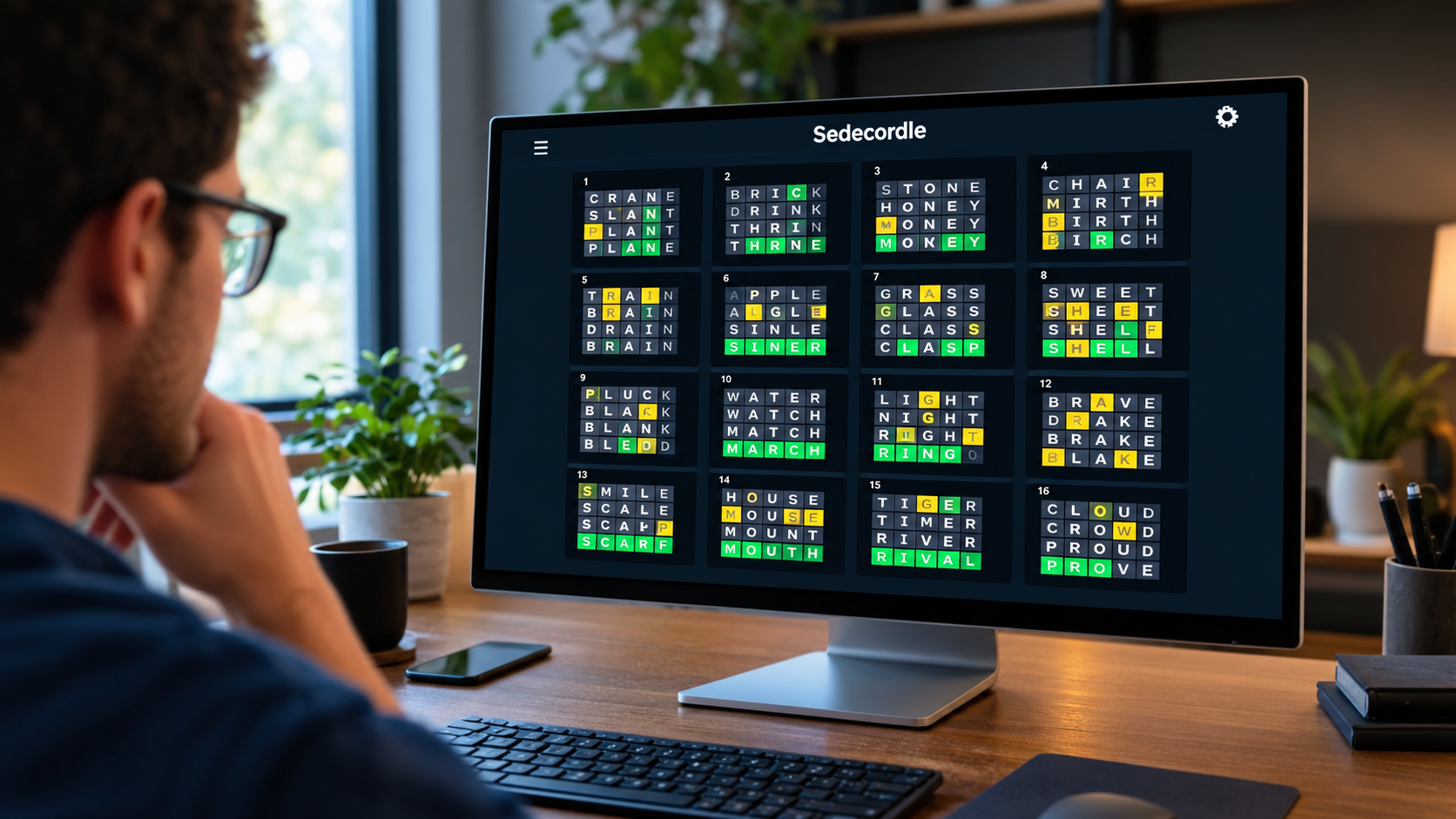
If you enjoy word games but feel that regular Wordle has become a little too easy, Sedecordle offers a much bigger challenge. Instead of trying to discover one hidden word, you have to work on sixteen different five-letter words at the same time. Every guess is applied across all sixteen boards, which means one carefully chosen word can provide useful clues in several places at once. The standard version gives you 21 guesses to solve all 16 words.
At first glance, Sedecordle looks similar to Wordle because the basic colour clues work in a familiar way. Green indicates that a letter is in the correct position, yellow means the letter belongs somewhere else in that particular word, and grey indicates that the letter is not present. The major difference is the scale of the puzzle. Instead of concentrating on one answer, you have to keep track of clues from sixteen separate grids.
That combination makes Sedecordle more than a simple vocabulary game. It becomes a test of memory, pattern recognition, elimination and decision-making. A good guess is not necessarily the word that solves one board immediately. Often, the better move is a word that tests several common letters and gives useful information across multiple unsolved boards.
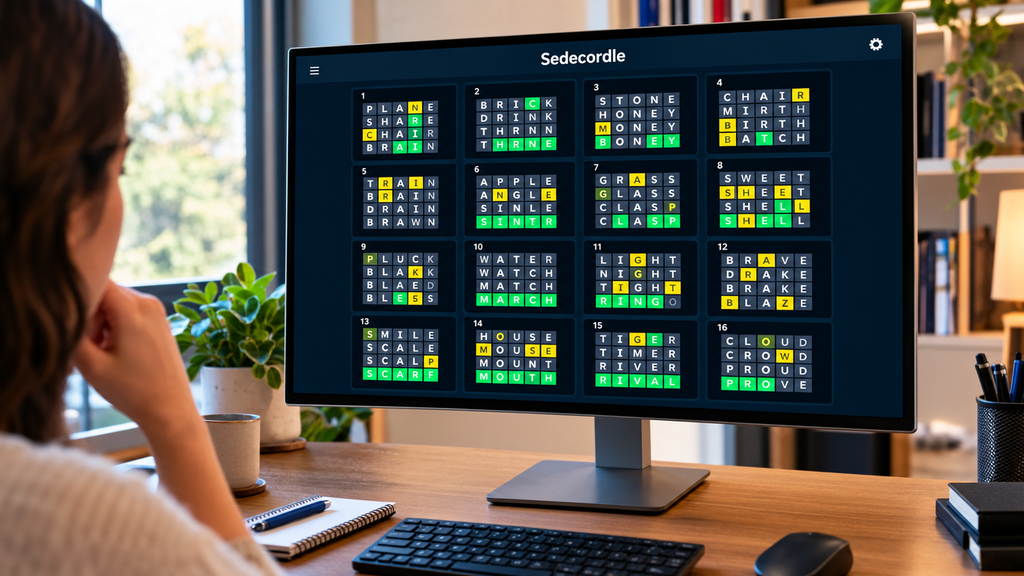
Sedecordle is a Wordle-style online word puzzle built around sixteen simultaneous hidden words. In the original version, players enter a valid five-letter word, and that single guess is checked against all sixteen answers. Each board provides its own colour feedback, allowing you to gradually narrow down the possibilities. The official Sedecordle site describes the standard challenge as solving all sixteen words in 21 tries.
The name itself reflects the number of puzzles involved. While Wordle asks you to solve one word, multi-board games increase the number of answers you must manage. Sedecordle takes that idea considerably further by putting sixteen boards into one challenge. This creates a very different experience because a guess that looks unhelpful on one board may reveal several important letters on another.
There is also a daily element that makes the game appealing to regular players. The original game provides a new Sedecordle puzzle each day, while practice-style options allow players to become familiar with the mechanics and improve their approach. The official game also includes variations such as Sedec-order, where words are solved one at a time rather than being displayed as one large collection of simultaneous boards.
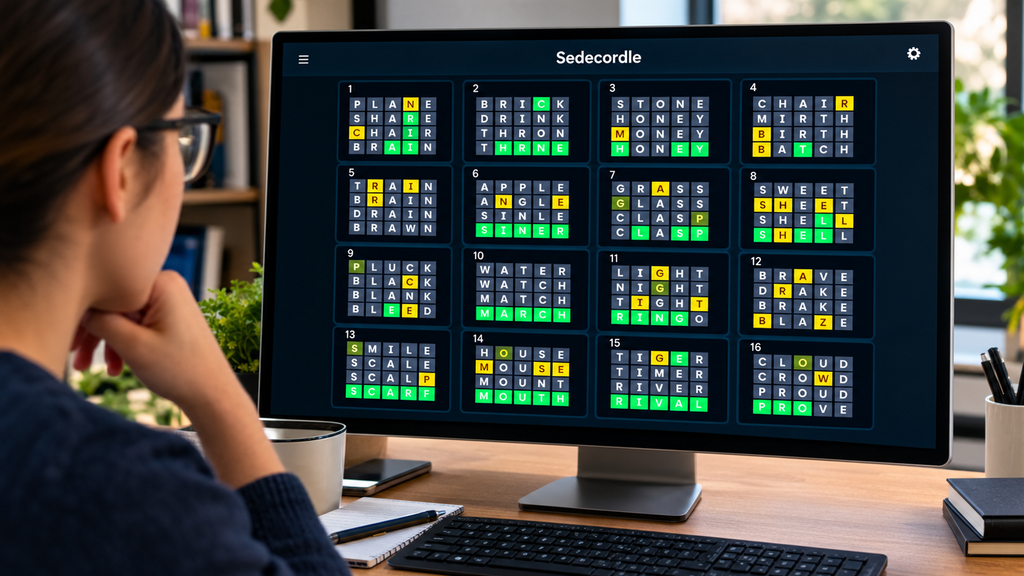
The basic objective is straightforward: solve all sixteen hidden words before you use your 21 available guesses. Each guess must normally be a valid five-letter word. Once you submit it, the game evaluates the letters separately for every board. That means the same word can produce green tiles on one board, yellow tiles on another and grey tiles somewhere else.
The colour system is important because every board has its own answer. A green letter tells you that both the letter and its position are correct for that particular word. A yellow letter tells you that the letter exists in that answer but is positioned incorrectly. A grey letter means the letter is not part of that specific target word. Understanding these clues quickly is one of the most important skills for improving at Sedecordle.
The real challenge comes from managing the information. You cannot simply treat the entire screen as one giant Wordle board. Each of the sixteen puzzles has different requirements, and a letter that is useful on one grid may be completely irrelevant on another. Good players therefore scan the boards after every guess, identify the words that are closest to completion, and decide whether the next guess should solve a word or gather additional information.
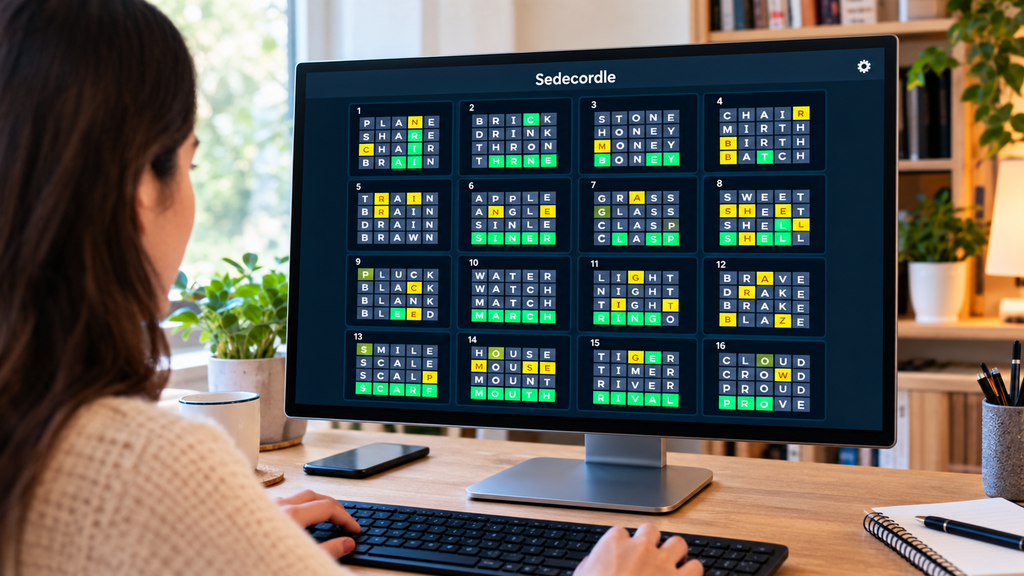
Start by choosing an opening word containing several common letters and useful vowels. You do not necessarily need to guess the answer immediately. Your first objective should be information. A strong opening word can reveal which letters are present across several boards and help you establish patterns much faster than a random guess.
After submitting your first word, examine the sixteen boards individually. Do not rush because one board looks promising. Look for green letters first, then yellow letters, and finally the grey letters that eliminate possibilities. Because the same guess is evaluated separately on every board, you may have sixteen completely different sets of clues after one turn.
As the puzzle develops, begin prioritising boards with strong patterns. If one grid shows several green letters and another has only grey tiles, the first board is usually closer to being solved. However, do not completely ignore difficult boards. With only 21 total guesses, leaving several complicated words until the final few turns can create unnecessary pressure. The best approach balances immediate solutions with useful information for the remaining boards.
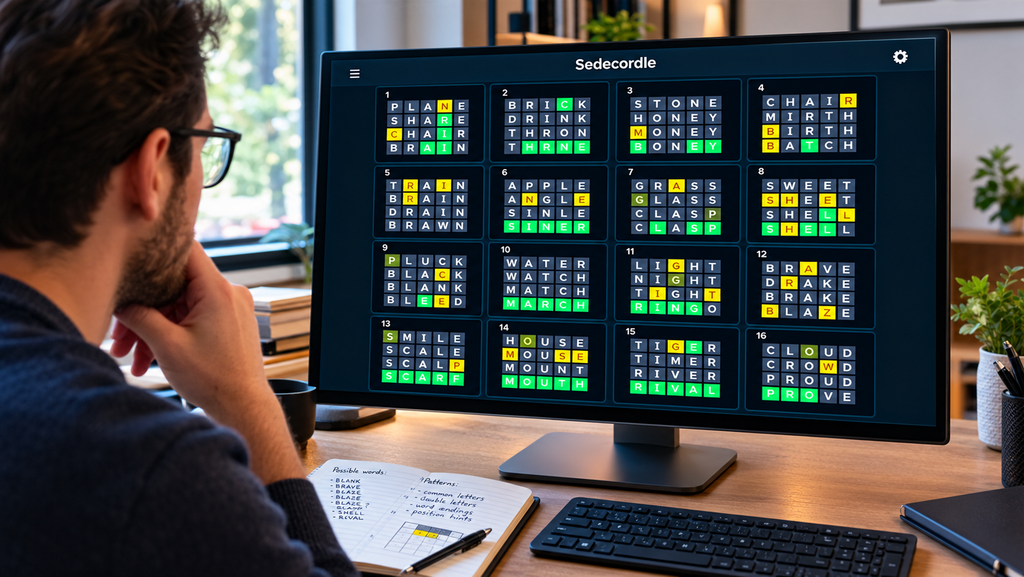
One of the most effective strategies is to think about information rather than simply thinking about answers. Early guesses should ideally contain common vowels and consonants that can help identify patterns on many boards. A word that reveals several letters across the sixteen grids can be more valuable than a highly specific guess designed to solve only one nearly completed word.
Another useful habit is to avoid becoming emotionally attached to one difficult board. Sometimes a puzzle appears to have only a few possible answers, but you may still lack enough information to choose correctly. Instead of spending several guesses testing tiny variations, move your attention to another board and collect more clues. New information from later guesses can eventually make the difficult word much easier to identify.
It is also important to remember the difference between yellow and green clues. A yellow letter is confirmed to be in the target word, but its current position is wrong. You should use that information actively rather than treating yellow as a weaker version of green. Combining yellow letters with known green positions can quickly reduce the number of possible answers. Current Sedecordle guides similarly recommend broad information-gathering early in the puzzle and more focused solving once patterns become clearer.
The biggest reason Sedecordle feels difficult is the relationship between the number of answers and the number of guesses. You are dealing with sixteen words but only 21 shared attempts. That leaves just five guesses beyond the number of words, so wasting several turns can make the final stages extremely difficult. Every guess therefore needs to have a purpose.
Wordle allows you to concentrate on a single word and use several attempts to understand its pattern. Sedecordle forces you to divide your attention. A guess that is perfect for one board might be useless for another. You need to constantly decide where your next move will create the most value, which makes the game feel more like managing a collection of small puzzles than solving one traditional word challenge.
The visual amount of information can also be overwhelming. Sixteen boards produce a lot of coloured tiles, and it is easy to overlook a useful clue. This is why organisation matters. Scanning the boards in a consistent order, remembering confirmed letters and eliminating impossible patterns can make the game considerably easier. The difficulty is not just vocabulary; it is also the ability to process many clues without losing track of them.
The original Sedecordle experience offers more than one way to play. The standard daily game provides a fresh challenge, while practice options allow players to spend more time learning the mechanics. This is particularly useful for beginners because the first few attempts can feel chaotic when sixteen boards are displayed together.
One interesting variation is Sedec-order. Rather than showing all the unsolved words in the same way, this mode focuses on one unsolved word at a time. Once you solve a word, the next board becomes available. This creates a more controlled experience and can be useful for players who find the standard multi-board layout difficult to manage.
The official Sedecordle site has also listed other variations involving different word lengths and additional gameplay formats. This gives experienced players a way to move beyond the standard five-letter challenge. If you already understand the basic strategy, experimenting with alternative modes can keep the game interesting while helping you become more comfortable with unfamiliar word patterns.
Sedecordle is worth trying if you enjoy word puzzles and want something substantially more demanding than standard Wordle. The basic rules are easy to understand, so there is not much of a learning barrier. The difficulty comes from applying those simple rules sixteen times at once while managing a limited supply of guesses.
It can also be a satisfying game for people who enjoy improving through repetition. Your first few games may involve lots of wasted guesses, missed clues and unfinished boards. Over time, however, you start recognising useful opening words, common letter combinations and patterns that appear frequently in five-letter vocabulary. That gradual improvement is a major part of the appeal.
The best thing about Sedecordle is that winning does not depend entirely on knowing obscure words. Strategic guessing matters just as much. If you learn to maximise information, track each board carefully and avoid wasting guesses, you can dramatically improve your results. For anyone looking for a challenging daily word puzzle, Sedecordle offers a simple concept with surprisingly deep gameplay.
The standard Sedecordle challenge contains 16 different hidden five-letter words. All sixteen boards are active at the same time, and each guess is applied across the boards.
You normally receive 21 total guesses to solve all sixteen words. Because the guesses are shared between the boards, it is important to avoid unnecessary attempts.
Yes. Sedecordle is considerably more demanding because you must track sixteen answers instead of one. The shared guess limit also means that inefficient guesses can hurt your chances of completing the entire puzzle.
Absolutely. The rules are simple enough for beginners, although the first few games can be challenging. Starting with practice games and focusing on information rather than immediate solutions can help new players learn the system.
Yes. The original Sedecordle experience provides a new daily puzzle, alongside other gameplay options such as practice and variations.