

Praiseear.co.uk is my home for friendly ear-care answers and practical next steps for people with questions about ear health. I write for U.S. readers who want clear information they can use, without medical jargon or pressure. Ear concerns can be distracting, and it can be hard to know what to do first. My goal is to make practical ear care easier to understand and help readers choose a sensible next step.
This site shares reader guidance, not a personal diagnosis or individual medical care. I explain common ear-health topics in plain language so readers can better understand their options. The right next step depends on the concern and a person’s health history, so general information cannot replace an individual assessment. Readers should seek a clinician’s advice when symptoms are severe, sudden, or persistent.
What Can I Find on Praiseear.co.uk?
I organize ear-care guidance around common concerns, safer choices, and the point at which a clinician should step in. Readers in the United States can use this ear health information to understand possible next steps, not to get a diagnosis or medical service.
My aim is to help readers find clear, practical next steps for common ear-health questions. Some topics explain how to notice a concern, while others describe care choices or when professional evaluation may help. I keep the focus on information readers can use in everyday decisions.
General ear-care guidance can help you decide what to do next, but it cannot assess your individual health.
The page groups guidance by the concern at hand. A reader who wants to understand a change in hearing can look for that topic, while someone considering ear care can start with safer choices. These subjects can overlap, so one concern may point to more than one useful topic.
I describe ear-care information and options, rather than offering medical services or personal advice. A clinician can assess symptoms and health history when individual care is needed. Readers can use the topic that matches their concern to find a practical next step.

How Can I Recognize an Earwax Blockage?
Earwax blockage affects about 10% of children and 5% of adults, and a blocked feeling is only one possible sign. Cerumen impaction means earwax buildup that blocks the ear canal. Symptoms can have other causes, so they do not confirm that wax is responsible.
Earwax symptoms can include several different changes, not just ear fullness. Common signs fall into these groups:
- Fullness or pain in the ear
- Hearing changes or tinnitus, a ringing or buzzing sound
- Itching inside the ear
- Ear discharge or an unusual odor
- Dizziness or balance trouble
These signs vary from person to person. Ear fullness may happen with a blockage, but pain, hearing changes, or dizziness can also come from other ear problems. A symptom list can help describe a concern, but it cannot identify its cause.
Some people have a higher chance of earwax buildup. Risk factors include using hearing aids, earplugs, or earbuds; having narrow or misshapen ear canals; and being over age 55. Using cotton swabs is another risk factor, but none of these factors proves that a blockage is present.
A clinician can assess the ear canal to see whether wax is blocking it or another issue may explain the symptoms. Keep track of when a symptom began and whether it is changing. New or worsening symptoms deserve attention even when earwax seems like the obvious explanation.
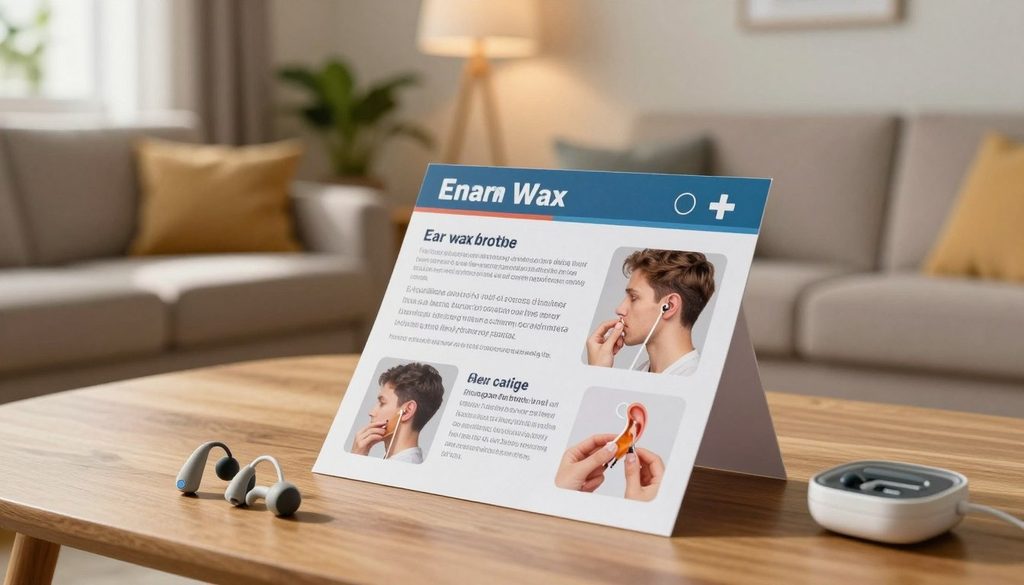
Using Earwax Drops Safely
Carbamide peroxide 6.5% is an FDA-recognized active ingredient in OTC earwax-removal aids, but its label directions apply only when the product is appropriate for the user. A cerumenolytic agent is a product that softens earwax. The product label and a clinical-trial protocol are different instructions.
Follow the directions on the specific product you use. A trial’s method does not replace the label or a clinician’s advice.
Carbamide Peroxide 6.5% Label Directions
For adults and children over 12, the label directs 5 to 10 drops per treatment, twice daily, for up to 4 days. This is the labeled schedule for carbamide peroxide 6.5% earwax removal drops. It is not a schedule for every ear product or every person.
The drops foam when they touch earwax as they release oxygen. That foaming may cause a cracking sound. The sound can be surprising, but it is a described part of how the product works. It does not show by itself whether the ear canal has cleared.
Different products can have different age labels. Eosera EAR WAX MD is labeled for adults and children ages 2 and older. Its age label should not be confused with the carbamide peroxide 6.5% label directions described above.
What the EAR WAX MD Trial Evaluated
The EAR WAX MD clinical trial included people whose ear canals were at least 50% blocked with cerumen. It was a single-arm study, meaning the trial evaluated the product without comparing it against another treatment group.
Participants received one or two applications, followed by irrigation. Researchers evaluated that sequence as the trial protocol. It is not a universal instruction for using the product, and the study does not establish that it works better than other options.
The trial reported one mild application-related adverse event: ear itching that resolved without treatment. It reported no serious application-related adverse event. Those findings describe the participants in this study, not every possible user or outcome.
Product age labels, directions, and trial methods serve different purposes. Check the directions for the product in hand rather than transferring steps from a study. Treat the trial’s one or two applications followed by irrigation as the protocol evaluated, not as a replacement for the product’s own directions or clinical advice.

When Professional Earwax Removal Is Safer
Ear tubes, a known or suspected eardrum perforation, or relevant ear surgery are reasons to get professional guidance before assuming wax is the cause. Eardrum history can affect which earwax removal methods are safe to consider.
Some symptoms and medical history call for evaluation before self-treatment. A clinician can check whether cerumen impaction is present and help choose a suitable approach.
Signs That Need Medical Evaluation
The carbamide peroxide 6.5% label says children under 12 should consult a doctor. It also says to ask a doctor before use in several situations:
- Ear drainage or discharge, ear pain, irritation, or rash
- Dizziness, an eardrum injury, or a known or suspected perforation
- Recent ear surgery, ear tubes, or a history of relevant ear surgery
- Bleeding from the ear or sudden hearing loss
- Significant dizziness or other symptoms that need prompt assessment
Bleeding, sudden hearing loss, and significant dizziness should not be assumed to come from wax. A clinician can assess whether another cause needs attention. The label cautions apply to the product, while the symptoms themselves may need medical evaluation.
Why Eardrum History Changes the Plan
The AAO-HNSF guideline, published January 3, 2017, identifies cerumenolytic agents, irrigation, and manual removal as separate options. A nonintact eardrum, including a perforation or ear tubes, changes cerumen management. The clinician considers the ear’s condition and relevant history before choosing an approach.
Professional evaluation can establish whether irrigation is appropriate when someone has a known or suspected perforation, ear tubes, or relevant surgical history. The table compares the main options, but it does not select one for an individual ear.
| Option | What it involves | Key consideration |
| Cerumenolytic agents | Ear drops that soften wax | Product directions and ear history matter |
| Irrigation | Water flushes wax from the canal | Professional evaluation can assess eardrum and surgery risks |
| Manual removal | A clinician removes wax with a tool | Choice depends on the ear and the blockage |
The guideline’s options describe distinct ways to manage wax, not a required order. A clinician can assess whether wax is the cause and whether irrigation is suitable. Stop using the labeled drops and ask a doctor if treatment would continue beyond 4 days or excessive wax remains.

Safer Habits for Ear Canal Care
A cotton swab may feel like a quick fix, but inserting objects into the ear canal is not recommended for wax removal. The AAO-HNSF recommends against putting objects into the canal to clean wax. The outer ear is the part to clean.
Keep objects out of the ear canal. Cotton-swab risks include pushing wax deeper or causing discomfort and injury.
Why Cotton Swabs Can Cause Problems
A 2025 cross-sectional survey of 229 adults recruited through Instagram found that 95.6% used cotton swabs for ear care. In that group, 60.3% used them mainly to remove earwax, and 14.4% reported daily use. Those figures describe the survey participants, not all adults.
Among cotton-swab users in the survey, 31.9% reported complications. These included ear discomfort in 21.4%, cerumen impaction in 10.5%, and hearing loss in 9.2%. The results show reported experiences, not proof that swabs caused every complication.
Most participants, 92.6%, knew medical professionals discouraged cotton-swab use. Still, 38.4% intended to continue using them, and 38.9% planned occasional use. Knowing the advice did not always change the habit.
Clean the Outer Ear Instead
Cleveland Clinic advises cleaning only the outside of the ear and putting nothing inside the canal, including cotton swabs. You can gently wipe the outer ear during regular washing. The canal does not need routine cleaning with an object.
Ear care tips can be simple: leave the canal alone and clean the visible outer ear. This avoids using a swab as a tool to reach wax deeper inside. Keep cotton swabs and other objects out of the canal and clean only the outer ear.
Hearing Changes and OTC Hearing Aid Options
Hearing concerns are common: about 15% of U.S. adults ages 18 and older, or 37.5 million people, report some trouble hearing. An OTC hearing aid is intended for adults with mild to moderate hearing loss, not children or every type of hearing difficulty.
Adults can buy OTC hearing aids without a hearing exam, prescription, or professional fitting. That access does not show whether a particular device fits an individual’s needs.
OTC hearing aids are intended for adults with mild to moderate hearing loss, not children.
Standard hearing exams show that about 1 in 8 people in the United States ages 12 or older, 13% or 30 million people, has hearing loss in both ears. About 28.8 million U.S. adults could benefit from hearing aids. The figures use different age groups and measures.
The three models below offer different power, phone, and control features. A feature list cannot establish medical fit, and the models are not ranked here.
| Model | Power | Phone or broadcast features | Controls or programming |
| Yeasound RIC800 | Rechargeable, up to 31 hours per charge | Bluetooth streaming with compatible iPhone and Android devices | Automatic Adaptive program, manual app settings, IPX8 water resistance |
| Audicus Omni 2 | Rechargeable or disposable batteries | No phone or broadcast feature specified here | Remote programming based on hearing results |
| Jabra Enhance Select M3 | Power type not specified here | Bluetooth LE Audio and Auracast broadcasts at supported venues | Feature details listed for Bluetooth LE Audio and Auracast |
Bluetooth features depend on the device and compatible equipment. Auracast broadcasts are available only at venues that support the technology. Sudden hearing loss calls for prompt medical evaluation rather than a trial of an OTC device.
You May Also Read: Sedecordle
Conclusion
The safest next step depends on whether the concern is routine ear care, a possible blockage, or a change in hearing. Keeping objects out of the ear canal is a simple way to avoid common cleaning risks. Severe, sudden, or ongoing symptoms need more than general information.
Use Praiseear.co.uk to find ear health guidance that matches your concern, then choose a practical next step. A clinician can assess symptoms and consider personal health history when individual advice is needed. Start with the guidance that matches your concern, and contact a clinician when symptoms warrant an individual assessment.
FAQ
Can carbamide peroxide drops make a cracking sound?
Yes, carbamide peroxide 6.5% drops may make a cracking sound because they foam on contact with earwax as they release oxygen. The label describes this sound as a possible effect of the foaming action. The sound alone does not show whether the ear canal is clear. Follow the directions on the specific product label.
Are OTC hearing aids intended for severe hearing loss?
No, OTC hearing aids are intended for adults with mild to moderate hearing loss. They are not meant for children or every type of hearing difficulty. Sudden hearing loss calls for prompt medical evaluation, rather than a trial of an OTC device. A clinician can assess significant or sudden hearing concerns and help determine an appropriate next step.
Do OTC hearing aids require a prescription or professional fitting?
No, adults with mild to moderate hearing loss can buy OTC hearing aids without a hearing exam, prescription, or professional fitting. That does not mean every model will suit every person. The Audicus Omni 2 supports remote programming based on hearing results. Its programming feature does not change the general OTC purchase rule.
Can children use OTC hearing aids?
No, OTC hearing aids are intended for adults, not children. This age limit differs from the label for eosera EAR WAX MD, which covers adults and children ages 2 and older. EAR WAX MD is an earwax product, not a hearing aid. Product age labels apply only to the product named on the label.
Will every OTC hearing aid stream audio from my phone?
No, phone streaming depends on the hearing aid model and device compatibility. The Yeasound RIC800 supports Bluetooth streaming with compatible iPhone and Android devices. That feature does not mean every phone or hearing aid will connect. Check the model’s compatibility details for the phone and operating system you use.