

FintechZoom.com is a broad financial news and information site, best used to scan market developments and build context rather than to execute trades. I see it as a useful starting point for US readers who need daily information, especially beginners learning how financial stories fit together.
A market index is a measure that tracks the performance of a selected group of stocks or other assets. FintechZoom.com can help readers follow financial news and spot themes, but an article or price display alone cannot support every investment decision.
I would use its coverage to learn what changed, which terms matter, and what question deserves a closer look. The goal is context, not a shortcut around careful research or personal judgment.
Treat it as a starting point for understanding a financial story, not as the final basis for an investment decision.
What Kind of Site Is It?
A reader can browse financial news, guides, and price pages on FintechZoom.com, but the site is not presented as a trading platform. Its main role is to publish information, not to take orders or hold customer funds.
The difference matters when a reader sees a stock or crypto price. A displayed price can provide market information without making the site an exchange or brokerage.
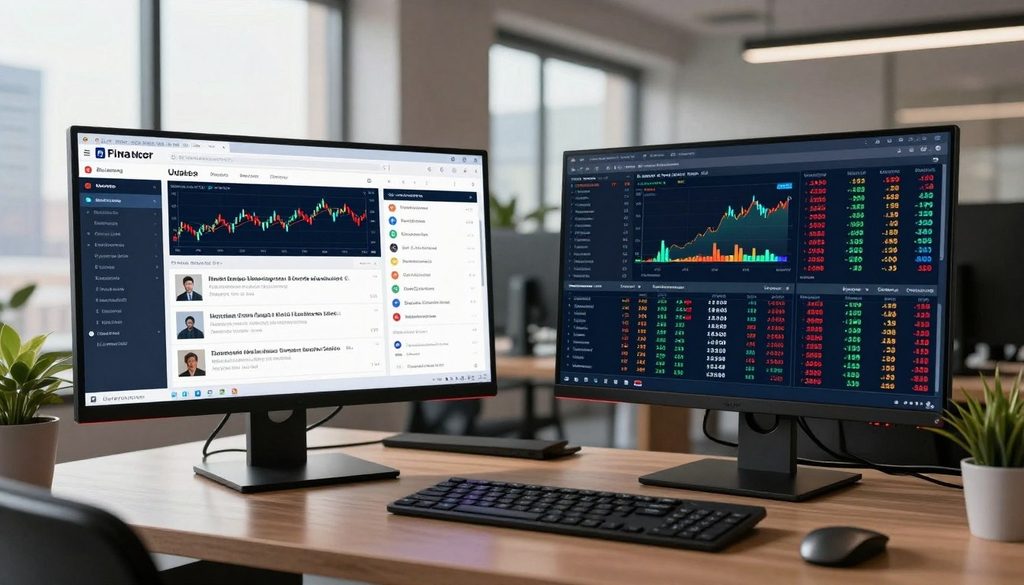
News articles report developments and explain terms. Guides offer background that can help a beginner follow a topic. Price pages display market information, but a price display does not by itself include an order book, where buyers’ and sellers’ orders appear.
A page that shows a price is not necessarily a place where a reader can place a trade.
A brokerage or exchange provides a financial service, such as accepting and routing orders. A reader should look for clear signs of that service, including account access and order controls, rather than assume that a market page supports trading.
The site’s footer shows a copyright range of 2016 to 2026. Its menu presents news, guides, and price pages, not a trading platform. That structure points to an information site, though the details of each page still matter.
Check whether a page is offering information or an actual financial service before treating it as a place to trade.
How the Site Is Organized
The six menu areas separate broad market coverage from household finance, crypto, business, economic, and lifestyle topics. That division can help readers move from a broad question to a more focused page.
For a US reader, the menu links financial news and information to different daily concerns. Markets and Economy focus on larger trends, while Money centers on household matters. The table shows what each area can help a reader find.
| Menu area | Coverage examples | Useful starting question |
| Markets | Indices and commodities | Which market measure changed? |
| Business | Company and industry developments | What changed for this company? |
| Crypto | Digital assets | What is moving in crypto? |
| Money | Household finance | What does this money term mean? |
| Economy | Jobs and inflation | What do new figures suggest? |
| Lifestyle | Broader personal-interest coverage | How does this topic affect daily life? |

These areas suit different questions, so readers do not need to treat every article as part of one market story. A company update may concern one business, while an inflation report can shape views across the economy.
The menu is most useful when a reader has a question in mind. I use a simple three-step path to keep browsing focused:
- Choose the topic area closest to the question.
- Scan a relevant article or price page.
- Note what question remains unanswered.
This process can help readers avoid spending time on content that does not serve their purpose. It also keeps a quick visit from turning into an unfocused scroll through money, business, and market news.
Start from the menu area closest to the question you want answered, rather than scanning unrelated sections.
Markets and Commodities in One Place
Readers can use the market section to scan 14 world benchmarks and pages for nine commodities. The range gives a quick view of different regions and asset types, rather than one complete view of every market.
The listed benchmarks cover the United States, Europe, and Asia-Pacific. Those three groups account for all 14 listed benchmarks. The examples below show how the pages are split by region.
| Region | Number of benchmarks | Examples | Coverage |
| United States | 4 | Dow Jones, S&P 500, Nasdaq Composite, Russell 2000 | Broad US benchmarks |
| Europe | 5 | FTSE 100, DAX, CAC 40, Euro Stoxx 50, STOXX Europe 600 | European benchmarks |
| Asia-Pacific | 5 | Nikkei 225, Hang Seng, Nifty 50, Shanghai index, ASX | Asia-Pacific benchmarks |

An index is a market measure, not a single stock. The Nasdaq Composite tracks a broad group of Nasdaq-listed stocks. The Nasdaq-100 tracks 100 major non-financial Nasdaq-listed companies, so the two measures do not represent the same group.
Commodity pages cover nine items across four groups:
- Energy: Brent crude, WTI crude, natural gas.
- Precious metals: gold, silver, platinum.
- Industrial metal: nickel.
- Agricultural products: corn, wheat.
A September 18, 2026, Dow report led with a 218-point drop, bond yields near 5 percent, and the coming triple witching. That example connected a stock market move with bond yields and an event calendar, giving readers more than a price change alone.
Check whether an index page means the Nasdaq Composite or Nasdaq-100, since the two track different groups of companies.
What Bitcoin Price Pages Can and Cannot Show
A Bitcoin price page can summarize short-term movement and market context, but it is not an exchange order book. It is a snapshot for following price changes, not a complete view of trading conditions.
FintechZoom.com Bitcoin price pages are described as typically updating every few seconds. They may show price changes over different intervals, shifts in market capitalization, volatility indicators, and commentary.
Price Movement and Market Context
Interval changes let readers compare a recent move with a longer stretch. Market capitalization estimates the value of the asset’s total supply at the displayed price. Volatility indicators can show how sharply prices have moved.

Commentary adds a quick context layer by describing a move or a market trend. Taken together, these features can help a reader frame what happened during the day, but they do not explain every cause behind a price change.
Data Limits During Volatility
The pages aggregate multiple market feeds rather than acting as an exchange-based data provider. That distinction matters because aggregated feeds and exchange-supplied order-book data serve different purposes.
An order book shows active buy and sell orders on a particular exchange. Liquidity information helps show how much can trade at different prices. The Bitcoin price page lacks those order-book and liquidity measures.
Possible data lag matters most during sharp moves, when prices can change quickly across venues. A display that refreshes every few seconds is not proof that its price is suitable for executing trades.
During a sharp move, use an exchange or other primary market source to confirm the price and available liquidity.
The Scope and Limits of Its Crypto Coverage
The crypto section covers a wide set of digital-asset topics, but its main role is accessible market context rather than technical due diligence. Its breadth can help beginners get familiar with terms and headline developments.
Coverage includes Bitcoin, Ethereum, altcoins, stablecoins, tokens, NFTs, blockchain, and the metaverse. Broader crypto content also touches on DeFi, digital assets, payment use cases, and beginner explainers.
Broad crypto coverage is not the same as specialized token or protocol research. A short news item may explain a development, but it may not test the design or economics behind a project.
Readers building a thesis about a token or protocol need evidence that matches the question. A specialist might examine details such as:
- Token supply and unlocks.
- Protocol documentation.
- Validator economics.
- On-chain activity.
- Liquidity.
- Governance.
Those details can affect how a digital asset works, who can influence it, and how easily it can be traded. A headline-level article may point toward an issue without giving enough data to judge it.
Introductory content can still help readers learn the basic vocabulary before they move to deeper research. It is most useful when treated as a map of the topic, not as proof of a token’s value or safety.
Use an introductory crypto article to identify the next question, then seek research that directly addresses that question.
Is fintechzoom.com Reliable for Financial Research?
FintechZoom.com can be useful for initial awareness, but public reputation signals alone cannot establish that every article is accurate. Reliability is best judged by checking the reporting and claims in the article itself.
Public scores describe different signals, not a complete measure of editorial quality. Readers can use them as context while keeping the article’s evidence at the center.
What the Public Signals Can Tell You
In October 2026, Semrush reported an Authority Score of 48 for fintechzoom.com, with 10.39K referring domains and 197.59K backlinks. The score and counts describe aspects of the site’s presence in search and links across the web.
As of March 31, 2026, the Trustpilot profile showed 4.0 out of 5 from four reviews. Its latest visible review was dated December 20, 2025. A review score describes those submitted ratings, not the accuracy of a specific market report.
What Those Signals Cannot Prove
An SEO metric does not verify an article’s claims, and four reviews are too small a sample to establish broad reader consensus. Neither figure confirms how carefully a writer checked a company report or market figure.
When I read financial news, I separate sourced reporting from interpretation and opinion. Sourced reporting points to records or named data; interpretation explains what those facts may mean; opinion gives a judgment.
Readers can also judge whether an article names dates, entities, and the basis for its claims. A clear distinction between fact and analysis makes it easier to understand what the writer knows and what the writer infers.
Judge the sourcing and clarity of the individual article, not just the site’s overall score.
What the Traffic Profile Shows
The October 2026 snapshot shows 19.16K visits, with most of the listed audience coming from the United States. These figures describe audience and visit behavior for one month, not the value of a particular article.
Traffic measures show how people reach and use a site, not whether its content is accurate. The table gives a dated view of the available audience measures.
| Measure | October 2026 value | What it describes |
| Visits and worldwide rank | 19.16K visits; rank 981,030 | Visit volume and global position |
| Visit behavior | 07:42 / 1.74 / 75.14% | Duration, pages per visit, and bounce rate |
| Leading visitor countries | United States 41.34%; India 15.19%; Canada 7.94% | Geographic share |
The site’s October 2026 US rank was 514,061. Direct visits made up 60.04% of traffic that month, and traffic was down 10.99% from September 2026.
Each measure answers a different question. Visit duration records time on the site, while pages per visit counts pages viewed during a visit. Bounce rate reports visits that did not continue to another page under the metric’s definition.
Those measures can help describe audience patterns, but they do not reveal why someone arrived or whether that person trusted the information. A direct visit can reflect many paths, including a saved bookmark or a typed address.
Read traffic metrics as a dated audience snapshot, not as a verdict on the usefulness of an individual article.
Personal Finance Topics on the Site
The Money section groups six household-finance topics, from mortgages and credit cards to insurance and interest rates. These topics can help readers learn terms and frame questions about borrowing or household money.
Its listed areas are mortgages, loans, credit cards, insurance, personal finance, and interest rates. General information can explain a term, but it does not assess a reader’s personal finances.
A mortgage explainer, for example, can help a reader understand how loan terms are described. An insurance article may clarify common coverage terms, while a credit-card guide can explain how interest rates affect balances.
Those explanations can help readers prepare clearer questions for a lender, insurer, or financial professional. They may also help a reader compare the words used in two offers without deciding which offer suits them.
The listed topics do not by themselves mean the site evaluates a reader’s income, credit history, goals, or eligibility. Those personal details can change which choice fits a household.
Use an explainer to clarify the question you need to ask about your own circumstances, rather than to assume it supplies a personal recommendation.
How to Verify a Market Claim Before Acting
Before acting on a price-sensitive headline, I would trace its central claim back to a dated primary source. The original record can show whether the headline reflects an actual filing, announcement, or market notice.
A headline is a prompt to verify a claim, not proof that the claim is complete or current. I use four checks before relying on a detail that could affect a financial decision.
- Locate the original announcement or filing.
- Confirm the date and the named entity.
- Compare any market figure with an exchange or established data provider.
- Check relevant regulatory material through the SEC, CFTC, or FinCEN when applicable.
Company investor-relations pages, exchange notices, and regulatory filings can provide primary-source records. The right place depends on the claim: a company statement may explain a business update, while an exchange notice may clarify a market rule.
US regulators also publish information about relevant financial matters. The SEC, CFTC, and FinCEN each cover different areas, so the claim determines which agency’s material may help.
Dates matter because a correct figure can become outdated, and names matter because similar companies or products can be confused. A headline may leave out a condition that appears in the original record.
If the original record does not support the headline’s key detail, do not use that headline as the basis for a trade.
Specialist Crypto Platforms Compared
For deeper crypto work, the right next resource depends on whether I need specialist reporting, asset research, or market data. Each type supports a different task and should not stand in for every other kind of evidence.
These resources are different tools, not interchangeable substitutes. I would match the outlet or service to the question I need to answer.
Crypto News and Journalism
CoinDesk and Cointelegraph are examples of dedicated crypto media. The Block and Decrypt are crypto-focused journalism, research, or analysis outlets, with a more crypto-native framing than a broad finance site.
Specialist media can help readers follow events within the sector. News coverage and analysis still differ: a report may describe an announcement, while analysis may consider its meaning or likely effects.
Data and Research Tools
Glassnode focuses on on-chain and market intelligence, while Messari offers crypto research and asset-level data tools. CoinGecko is a crypto market-data aggregator.
| Resource type | Examples | Useful for | How it differs from a broad finance site |
| Dedicated crypto media | CoinDesk and Cointelegraph | Beat-focused news coverage | More crypto-specific editorial focus |
| Crypto journalism and research | The Block and Decrypt | Specialized reporting and analysis | More crypto-native framing |
| Data and research tools | Glassnode, Messari, and CoinGecko | On-chain context, asset research, or broad market data | More data-oriented workflows |
A data tool can help answer a question about asset activity or market prices. It does not replace reporting that explains an event, and an article does not replace direct data when a precise measure matters.
Choose a resource for the specific evidence needed, rather than treating any one platform as a complete research process.
Readers Who Benefit Most
FintechZoom.com is most likely to help readers who want accessible explanations and a broad view of what is moving. The best fit depends on the reader’s task, not on wealth or assumed skill.
Beginners and casual investors can use broad context, while serious traders usually need more specialized evidence. The difference is how much detail and timing a decision requires.
Beginners and Casual Readers
Plain-language explanations can help beginners learn financial terms and follow a market story. Casual investors may use broad news coverage to keep track of trends without studying every price move.
For someone learning how stocks, interest rates, or digital assets work, an accessible article can make later research easier to follow. Quick context can also help readers see why a headline matters to a company or market.
Active and Advanced Market Participants
Active traders often need information that changes with market conditions, along with tools suited to their strategy. An article summary may not provide the detail needed for a time-sensitive trade.
A high-conviction decision can call for more than a broad market view. The reader may need specific data, a clear thesis, and evidence that speaks to the asset or event in question.
The same general article can be useful for background and still fall short for a complex decision. Experience does not remove the need to match the evidence to the task.
The more a decision depends on precise timing or a detailed thesis, the less appropriate a general article alone becomes.
Financial Risks and the Site’s Disclaimer
FintechZoom.com says its content is informational and not financial or investment advice. That limit matters because a general article cannot know a reader’s full situation.
The site warns that readers can lose all the money they invest in crypto or other financial products. That is a full-loss warning, not a claim limited to small price changes.
Investments can lose value, and the risk may extend to losing the full amount invested. Readers should not treat an article’s explanation or market view as a promise of a result.
The site’s disclaimer also notes that rules for crypto and digital assets vary across jurisdictions. A rule that applies in one place may differ from the rules where another reader lives.
That difference can matter when people use digital-asset services or take part in crypto markets. Readers need to consider the rules that apply in their own location, along with the financial risks of an investment.
Even careful research cannot remove every risk from a financial decision. The amount at stake and the chance of loss deserve attention before a reader acts.
Treat the possibility of losing the full amount invested as a real risk, not as boilerplate.
A Practical Daily Reading Routine
A short, focused scan is more useful than trying to follow every headline across every financial topic. A simple routine can help readers organize market news without turning browsing into a trading signal.
Use three steps to keep a daily scan focused on one useful question. I would choose a topic tied to my watchlist, then record what the article says and when it says it.
- Choose one topic area relevant to your watchlist.
- Write down the article’s central claim and its date.
- Decide whether the claim merits separate follow-up before a decision.
A watchlist could concern a company, an index, or a financial issue that affects a household. Focusing on one topic makes it easier to notice useful changes without reading every story on the site.
Writing down a claim and date creates a simple record of what caught your attention. It also helps distinguish a new development from an older item that still appears in a feed.
The last step is a pause, not a buy or sell signal. A headline may raise a question that deserves more work, or it may be background with no effect on the reader’s plans.
A daily scan organizes attention; it does not turn a headline into a decision rule.
Keep a note of the question a headline raises, and make a separate decision only after the needed evidence is in hand.
You May Also Read: Sedecordle
Conclusion
FintechZoom.com is most useful as a convenient first stop for financial context, not as a complete research or trading system. I would use it to scan broad topics and understand why a market story may matter.
Important claims and decisions need support beyond a single article. That extra evidence should match the question, whether it concerns a company, market figure, or financial product.
Readers can keep their next step small and concrete. Choose one current claim that matters to you and check its underlying source before acting on it.
FAQ
Is FintechZoom.com affiliated with the Nasdaq exchange?
No, a page about a Nasdaq index does not establish that FintechZoom.com is affiliated with the Nasdaq exchange. A finance publisher can discuss an exchange, its listed companies, or a benchmark without being part of that exchange. Treat the publisher and the exchange as separate entities unless a clear business relationship is stated.
Does every FintechZoom.com price display update in real time?
No, the site does not have one established update rate for every price display. Its Bitcoin pages are described as refreshing every few seconds, but that does not set the rate for other pages. The provider and timestamp on an individual display help show when its information was updated.
What is the difference between the Nasdaq Composite and the Nasdaq-100?
The Nasdaq Composite tracks a broad group of Nasdaq-listed stocks, while the Nasdaq-100 tracks 100 major non-financial Nasdaq-listed companies. The two indices therefore cover different groups, even though both relate to Nasdaq-listed firms. A reader comparing performance should check which benchmark a report names before drawing conclusions.
Does a 4.0 Trustpilot rating establish broad customer consensus?
No, a 4.0 Trustpilot rating from four reviews does not establish broad customer consensus. As of March 31, 2026, the profile showed that rating and review count, with the latest visible review dated December 20, 2025. Four reviews provide a small sample, so the score cannot represent all readers’ views.
Does direct traffic mean readers trust a financial site?
No, direct traffic describes how visits arrive, not whether readers trust the site’s content. A direct visit can come from a typed address, saved bookmark, or another route that analytics records as direct. The traffic share alone says nothing about how a reader judged an article or its claims.
Can I use a FintechZoom.com article as personalized financial advice?
No, FintechZoom.com describes its content as informational, not as personalized financial advice. A general article does not assess your income, goals, credit history, or tolerance for risk. Consider your own circumstances and the chance of loss before making a financial decision based on information you have read.